
Florida HOA and condominium audits, reviews, and compilations.
One organized request list, a schedule agreed before the work starts, and a report your board can actually read.
Request a Proposal What report does your association need?
What report does your association need?
Your association's total annual revenue sets the minimum level of year-end financial reporting Florida law requires. The tiers are the same for homeowners' associations under section 720.303(7) and condominium associations under section 718.111(13), Florida Statutes.
| Total annual revenues | Minimum year-end report |
|---|---|
| Under $150,000 | Report of cash receipts and expenditures |
| $150,000 to less than $300,000 | Compiled financial statements |
| $300,000 to less than $500,000 | Reviewed financial statements |
| $500,000 or more | Audited financial statements |
| HOA with at least 1,000 parcels | Audited financial statements, regardless of revenue |
Your governing documents may require a higher level than the statute does, and so may a lender, an insurer, or a buyer's title company. The report must be prepared and completed, or contracted for, within 90 days after fiscal year end unless your bylaws set a different date.
Deadlines, member delivery, and how members vote to change the level
Why Coastal Clarity
An association-only practice
Audits, reviews, and compilations for Florida HOAs and condominium associations. This is the only work the firm does. There is no competing tax season pulling capacity in February and March, which is exactly when December year ends need attention.
An organized engagement
One document request list up front, a schedule agreed at the proposal stage, secure document exchange, and open items communicated as they arise instead of at the end.
Direct CPA involvement
The CPA you talk to plans, directs, reviews, and signs the report, and is your point of contact throughout. You are not handed off after the proposal.
What the engagement looks like
Dates below assume a December 31 fiscal year end.
-
October – November
Engage before year end
The engagement letter is signed and returned before December 31, so the work is planned into the schedule rather than squeezed in later.
-
January
Close the books
Accounts reconciled, agings tied to the balance sheet, transactions coded to operating or reserve funds, general ledger closed.
-
January – February
Deliver the document package
One organized delivery against the request list you received at the start, rather than a trickle of files after fieldwork has begun.
-
February
Fieldwork
Reconciling accounts, testing transactions, reading minutes, and raising questions as they come up instead of saving them for the end.
-
February – March
Draft, representation letter, final report
The board reviews the draft and any proposed adjustments, the designated officers sign the representation letter, and the final report is issued and delivered to members.
The full document request list and the six things that stall audits
The Association Financial Snapshot
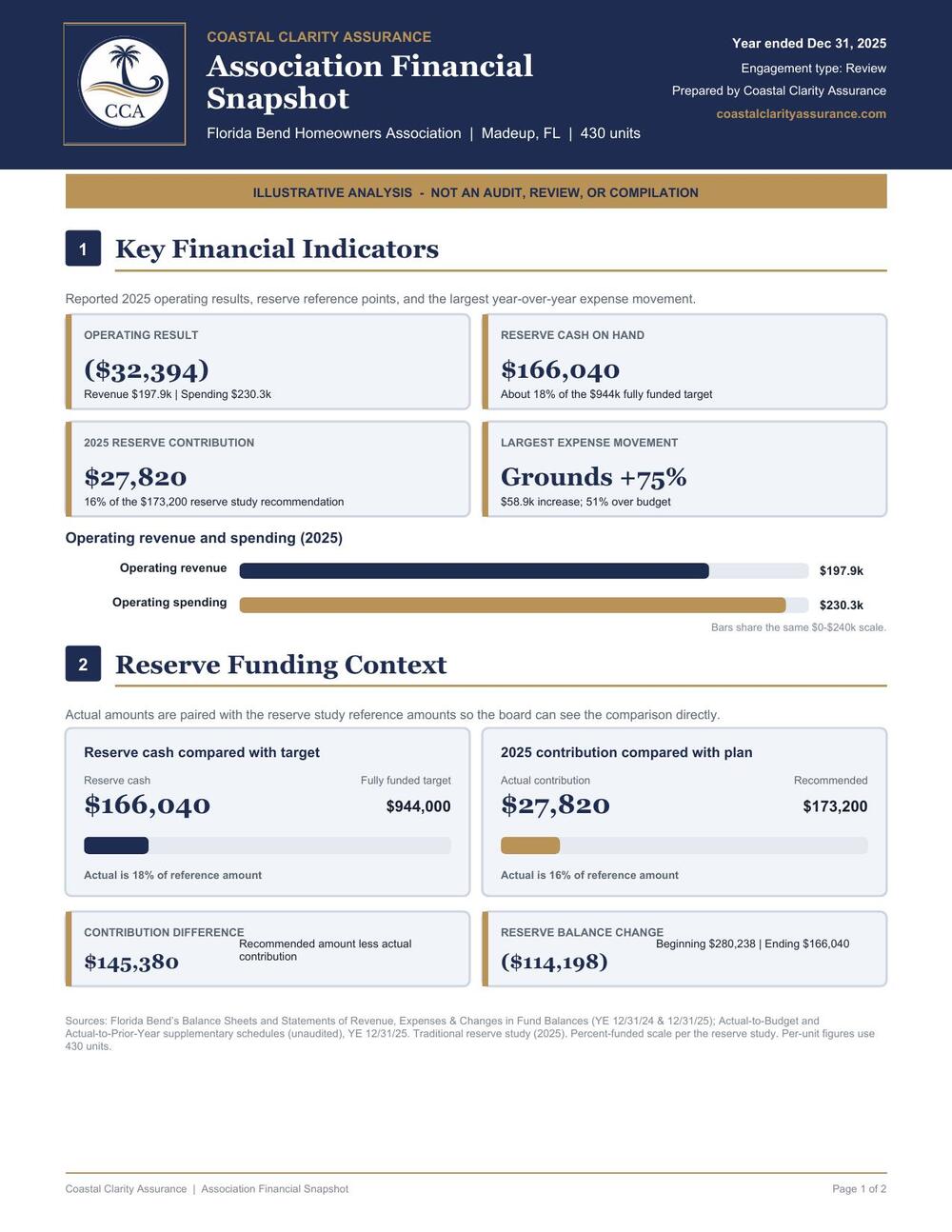
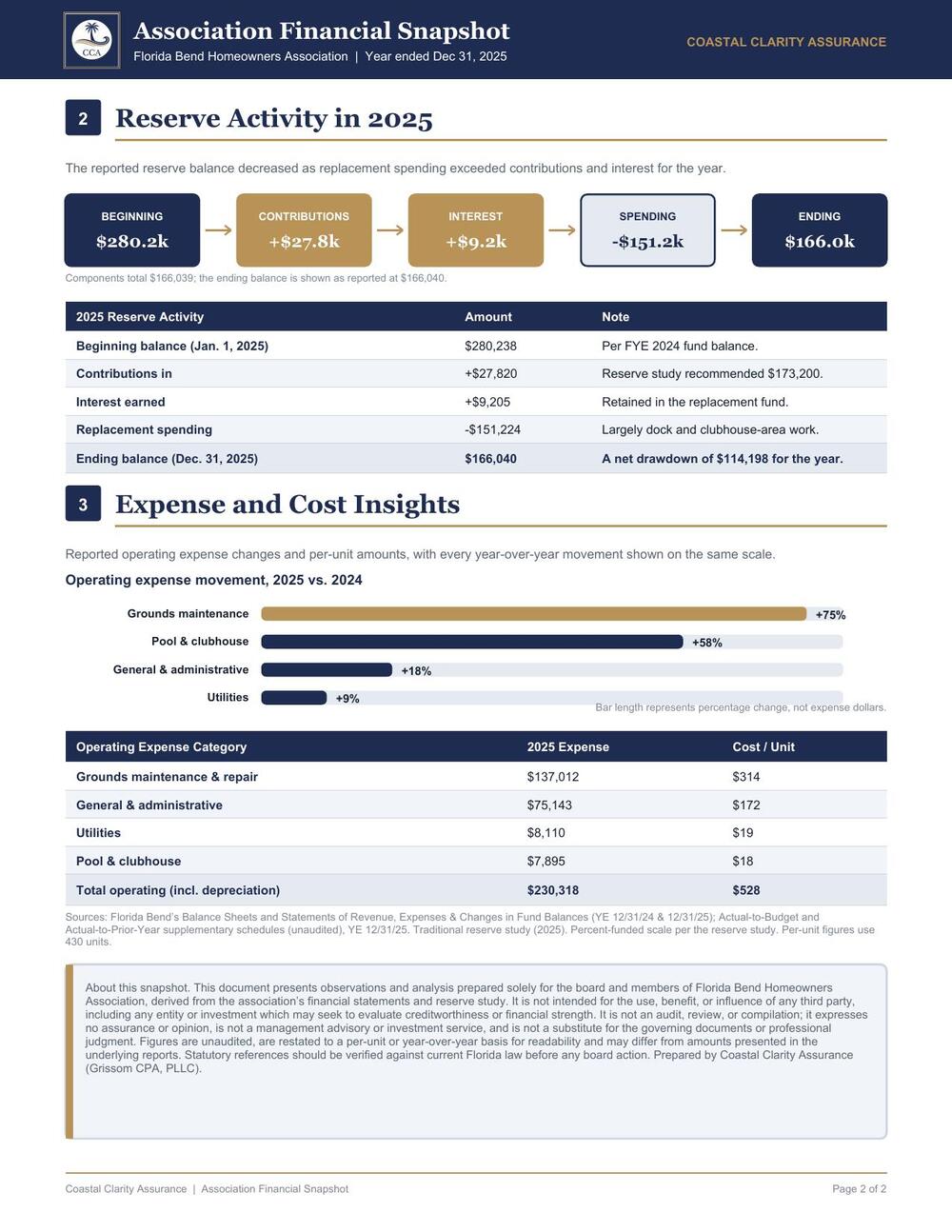
Every engagement includes a two-page Association Financial Snapshot: operating results against budget, reserve cash against the reserve study's fully funded target, contribution against the study's recommendation, reserve fund movement, expense movement year over year, and cost per unit.
The sample shown uses a fictional association. Reserve measures such as percent funded and funding gap are stated against the reserve study's recommendation, not against any statutory funding requirement, which Chapter 720 generally does not impose on an HOA.
Managing a portfolio of associations?
One request list, a schedule agreed at proposal, and open items raised as they arise. How we work with CAM firms and managers
The Audit Preparation Guide for Florida Community Associations
What Florida law requires, what your CPA will ask for, and how well-prepared associations get their reports done on time. Free and ungated. Managers are welcome to forward it to every board they serve.

The principal
R. Scott Grissom, CPA, MBA
Scott is the principal of Grissom CPA, PLLC, which practices as Coastal Clarity Assurance. He built the firm around a single line of work: assurance engagements for Florida community associations. He plans, directs, reviews, and signs every report the firm issues, and he is the person a board or a manager talks to from the proposal through delivery.
The firm is a member of the AICPA, the Florida Institute of CPAs, and Community Associations Institute.